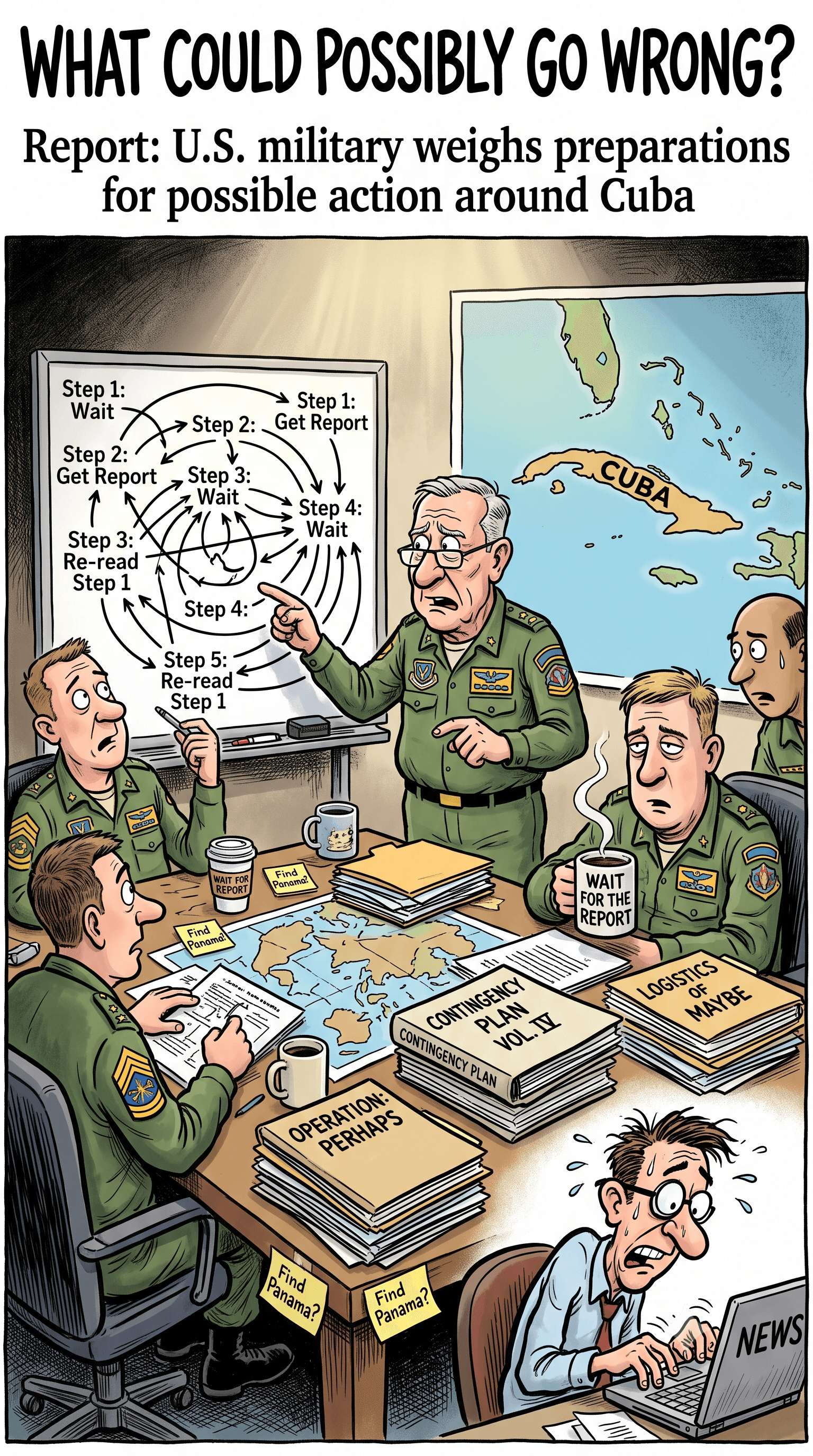
In recent days, new revelations have emerged suggesting an escalation in the United States' military posture toward Cuba. According to a recent media report, the US military is laying the groundwork for potential action focused on the island nation. These developments follow months of mounting diplomatic tensions, economic pressure, and geopolitical maneuvering between Washington and Havana.
Internal Army Message Signals Heightened Military Planning
An internal message from the US Army Reserve headquarters, recently obtained and reviewed by CBS News, reveals that the military branch is weighing whether it can provide a range of support units to the US Southern Command (SOUTHCOM). While the internal document did not explicitly mention Cuba by name, multiple anonymous US officials informed CBS News that the request is directly connected to continued military planning concerning the Caribbean nation.
The military formations requested for potential availability within a 90 to 120-day window include:
Military Police and Medical Support: Information was sought regarding the availability of a military police brigade, a medical brigade, and a forward surgical unit capable of providing trauma and emergency care near deployed forces.
Logistics and Engineering Units: The Army Reserve headquarters requested assessments for an engineer battalion, an expeditionary sustainment command to oversee military logistics across a theater of operations, and a combat sustainment support battalion tasked with transportation, maintenance, fuel, and supplies.
Despite the detailed nature of the resource request, the internal message did not indicate that any units have already received deployment orders. Instead, it functioned as an inquiry seeking feedback from subordinate commands to gauge the possible availability of extra personnel and military resources.
The Trump Administration’s Stance and Economic Pressure
These military preparations are unfolding against a backdrop of intensified political pressure orchestrated by the Trump administration. For nearly nine months, the United States has subjected Cuba to rigorous economic strain, which has included a naval blockade intended to compel political reforms on the island.
The administration's public rhetoric has also grown increasingly assertive. During an address to the United Nations General Assembly on September 22, 2026, President Donald Trump stated that his administration was seeking a "fundamental change" in Cuba and predicted that its communist government "will fall". He further declared that "freedom will be coming to Cuba" and emphasized that the United States is prepared to use military power where necessary to protect its vital interests in the Western Hemisphere. In response to these statements, the Cuban delegation walked out of the UN hall. Earlier in the year, President Trump had openly discussed his thoughts on the nation, stating he had considered "taking Cuba" and commenting that "Cuba's going to be next" following operations in Venezuela and Iran.
The US government has cited concerns regarding Cuba's strengthening relations with geopolitical adversaries, specifically Russia, China, and Iran. Consequently, Washington imposed new sanctions targeting Cuban entities just days before the UN assembly. These measures, aimed at actors involved in activities supporting the country's military capabilities and mining sector, designated four military enterprises involved in research and development, three military officials, and four state-run enterprises linked to Cuba's nickel reserves.
SOUTHCOM, Reconnaissance, and Prior Planning
When questioned about the potential deployment of units, a spokesperson for US Southern Command declined to disclose specific movements or potential deployment timelines, citing operational security concerns. However, the spokesperson confirmed that SOUTHCOM continuously coordinates with joint forces to assess potential requirements across its area of responsibility in support of assigned missions.
These recent logistical inquiries follow a pattern of previously documented military activity. According to US military personnel who spoke with CBS News, American forces have conducted reconnaissance operations of the seafloor and maritime approaches around Cuba. Furthermore, in July, military planners examined several operational options, which included a potential Army-led air assault utilizing thousands of soldiers from the 101st Airborne Division. At times, air components were placed on heightened readiness, and personnel were prepared for possible deployments that were ultimately not carried out. Additionally, US intelligence officials have reportedly analyzed how Havana might respond to potential American military action.
Cuba’s Defensive Posture and Diplomatic Response
In Havana, the response to the mounting pressure and military planning has been firmly defensive. Cuban President Miguel Diaz-Canel has publicly vowed to counter any US attack, accusing Washington of engaging in "aggression" and "economic warfare" by actively blocking oil imports to his country.
Historically, Cuba has maintained a high-alert defensive posture against perceived threats from the north. Earlier in 2026, the Cuban government hosted countrywide defensive drills and ordered its forces to prepare for war in anticipation of a potential invasion. While Cuban officials, such as Deputy Foreign Minister Anayansi Rodriguez Camejo, have stated that the nation's political system is "not up for negotiation," they have also signaled an openness to dialogue based on sovereign equality regarding issues of mutual interest.
Despite the hostile rhetoric, diplomatic channels have not been completely severed. During his UN address, President Trump acknowledged that US Secretary of State Marco Rubio was "deep into negotiations" with the Cuban government.
Distinguishing Contingency Planning from Authorized Intervention
While the latest reports describe increasingly specific contingency planning, legal and political analysts note that internal military preparation differs from an authorized invasion or a communicated intention to employ force. US military officials cited by CBS News expressly distinguished this planning phase from a finalized executive decision, stressing that the briefings did not mean President Trump or the Pentagon had decided to order a military operation.
According to legal experts, regime-change objectives, ideological opposition, and military preparedness do not independently provide lawful authority for an invasion under international law. If US and Cuban forces were to engage in hostilities, international humanitarian law would apply to the resulting international armed conflict.
Outlook: What Comes Next in US-Cuba Relations?
As the situation develops, the US military preparations regarding Cuba serve as a critical focal point in Western Hemisphere geopolitics. The 90 to 120-day readiness window outlined in the Army Reserve's internal message suggests that the Pentagon is actively structuring logistical options for the coming months.
Whether these preparations will materialize into physical deployments, or if they are intended to serve as a coercive negotiating tactic to extract diplomatic concessions, remains uncertain. For now, the international community watches closely as high-stakes diplomacy runs parallel to robust military contingency planning, leaving the future of US-Cuba relations delicately balanced.