A fierce clash of narratives has emerged following an Iranian ballistic missile barrage on the Muwaffaq Salti Air Base in Jordan overnight Tuesday into Wednesday. While multiple anonymous US officials assert that American military aircraft sustained damage in the strike, President Donald Trump has publicly and explicitly denied that any such damage occurred.
The stark contradiction between the President’s public assurances and the detailed accounts leaked by defense and intelligence officials highlights the intense political and strategic stakes of information control during an active military conflict.
Anonymous Sources Report Damage to US Warplanes
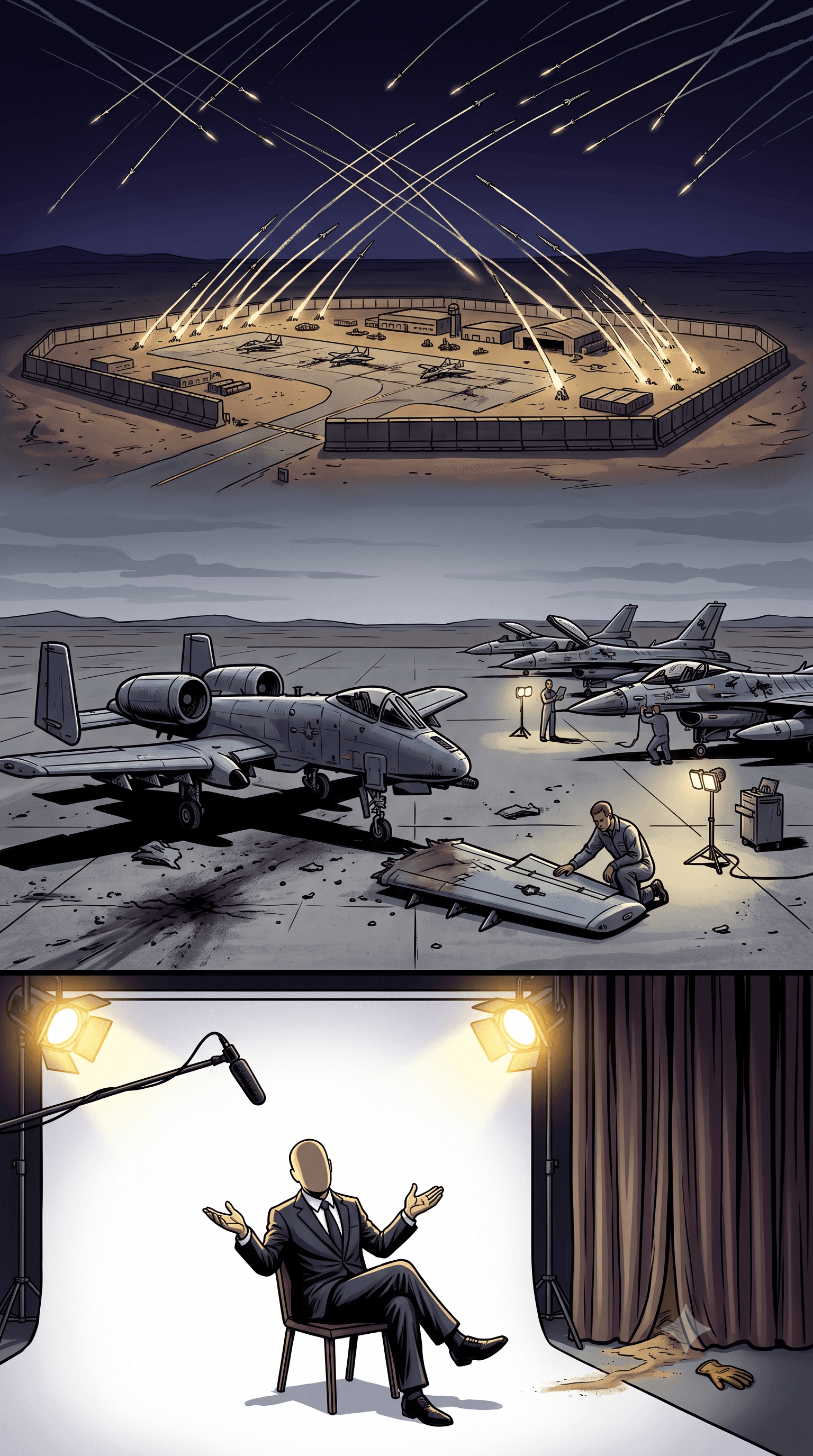
The controversy centers on a wave of Iranian ballistic missiles fired at military installations in Jordan. According to initial reporting by CBS News, citing people with direct knowledge of the matter who spoke anonymously because they were not authorized to speak publicly, the barrage successfully penetrated base defenses and struck American military hardware.
These anonymous sources provided highly specific details regarding the battle damage. They reported that one A-10 Thunderbolt II attack aircraft—commonly known as the "Warthog"—was struck and lost a wing. Furthermore, roughly eight F-15E Strike Eagle fighter jets reportedly sustained light damage but were quickly evaluated and returned to active service. All sources across multiple outlets have concurred that there were no American casualties or deaths in the strike.
Despite the highly specific nature of these leaks, the claims remain strictly unofficial. As of this writing, the Pentagon, US Central Command (CENTCOM), and the Department of Defense have not issued any on-the-record statements confirming or denying the specific reports of aircraft damage. If such damage occurred, no authorized military spokesperson has yet stepped forward to officially acknowledge it.
Trump Contradicts Reports: "No Damage. No Nothing."
President Donald Trump directly contradicted the anonymously sourced reporting during a recent media appearance, firmly denying that any American aircraft were harmed.
In an interview with NewsNation, Trump dismissed the reports of damaged US warplanes at the Jordanian installation. “There is no truth” to the reports, the President stated, adding, “No damage. No nothing.”
The President’s forceful denial is currently the highest-level, on-the-record statement regarding the outcome of the Muwaffaq Salti strike. By stating unequivocally that American equipment escaped unscathed, Trump has drawn a firm line that puts the White House completely at odds with the narrative leaked by defense insiders to major news networks.
Official Responses and Base Defenses
While the Pentagon remains silent on the status of the F-15s and the A-10, official channels have focused heavily on the defensive measures deployed during the attack and the safety of American personnel.
An American official speaking on the record to Fox News characterized the Iranian attack as "ineffective," emphasizing that "American forces have 100% accountability at all locations in Jordan." According to CBS News, US and allied forces fired more than thirty Patriot missile interceptors to defend the base from the incoming barrage.
The Jordanian military also released a public statement regarding the attack. Jordan’s Armed Forces reported that they engaged 20 incoming Iranian ballistic missiles, successfully intercepting 18 of them. The military stated that the remaining two missiles fell in uninhabited areas. Crucially, Jordan has not publicly commented on any potential damage to US aircraft or facilities on its sovereign territory, leaving the question of base damage officially unanswered by the host nation.
Escalating Reprisals in the US-Iran Conflict
The strikes on Jordan represent the latest escalation in a widening, multi-front conflict between Washington and Tehran. The current status of the war is highly volatile, characterized by a continuous tit-for-tat exchange in the Middle East.
The Iranian missile barrage was launched as a direct retaliation for preceding US military operations. Just prior to the attack on Muwaffaq Salti, US forces carried out strikes sinking five Iranian tankers, part of a broader campaign by Washington to aggressively target the financial networks funding the Islamic Revolutionary Guard Corps (IRGC).
In response, the IRGC has launched its own sweeping claims. Iranian state media claimed that IRGC forces attacked eight tankers and two US Navy warships. Furthermore, the IRGC claimed that its missile barrage targeted not only Muwaffaq Salti but also the Prince Hassan air base. (CENTCOM has officially denied that any US Navy warships were struck, stating that all IRGC attempts against naval vessels failed).
Analyzing the Fog of War: Why Battle Damage is Disputed
For a general reader, the gap between specific, leaked casualty reports and broad, official denials can be confusing. However, disputes over Battle Damage Assessments (BDAs) at forward operating bases are a common feature of modern warfare.
First, officials often speak anonymously to the press because official BDAs are highly classified. Revealing exactly what was destroyed, and how it was hit, can provide the enemy with crucial intelligence about the effectiveness of their targeting systems and the weaknesses in US air defense umbrellas (such as the Patriot missile batteries).
Politically, there is immense pressure surrounding the acknowledgment of damage. In an ongoing conflict, admitting that an adversary successfully breached defenses and destroyed multimillion-dollar assets can be seen domestically as a sign of weakness. Strategically, acknowledging a severe hit often places immense political pressure on a Commander in Chief to escalate the conflict in response.
Conversely, denying damage allows an administration to control the escalation ladder, keeping the temperature of the conflict manageable. The journalistic challenge is that anonymous officials often leak accurate damage reports because they believe the public has a right to know the reality of the war, or because they disagree with the political management of the narrative. Since the initial CBS report, other major outlets—including Fox News and Air & Space Forces Magazine—have stood by the reporting, citing their own anonymous sources corroborating the damage to the A-10 and F-15s, even in the face of the President’s denial.
Outlook
The US-Iran conflict shows no signs of immediate de-escalation. With energy and commercial shipping facing intense pressure in the Strait of Hormuz, and global benchmark oil prices spiking over $100 a barrel, the economic fallout of the military standoff is accelerating. The contradiction between anonymous defense officials and the President regarding the Jordanian base strike underscores a deeply polarized information environment. Until commercial satellite imagery or declassified DOD photos emerge to definitively prove or disprove the damage at Muwaffaq Salti, the true operational cost of the Tuesday night barrage will remain shrouded in the fog of war.
#USMilitary #IranConflict #MuwaffaqSalti #Jordan #MiddleEastWar #A10Warthog #F15StrikeEagle #DefenseNews #Geopolitics #BattleDamage #NationalSecurity #ForeignPolicy