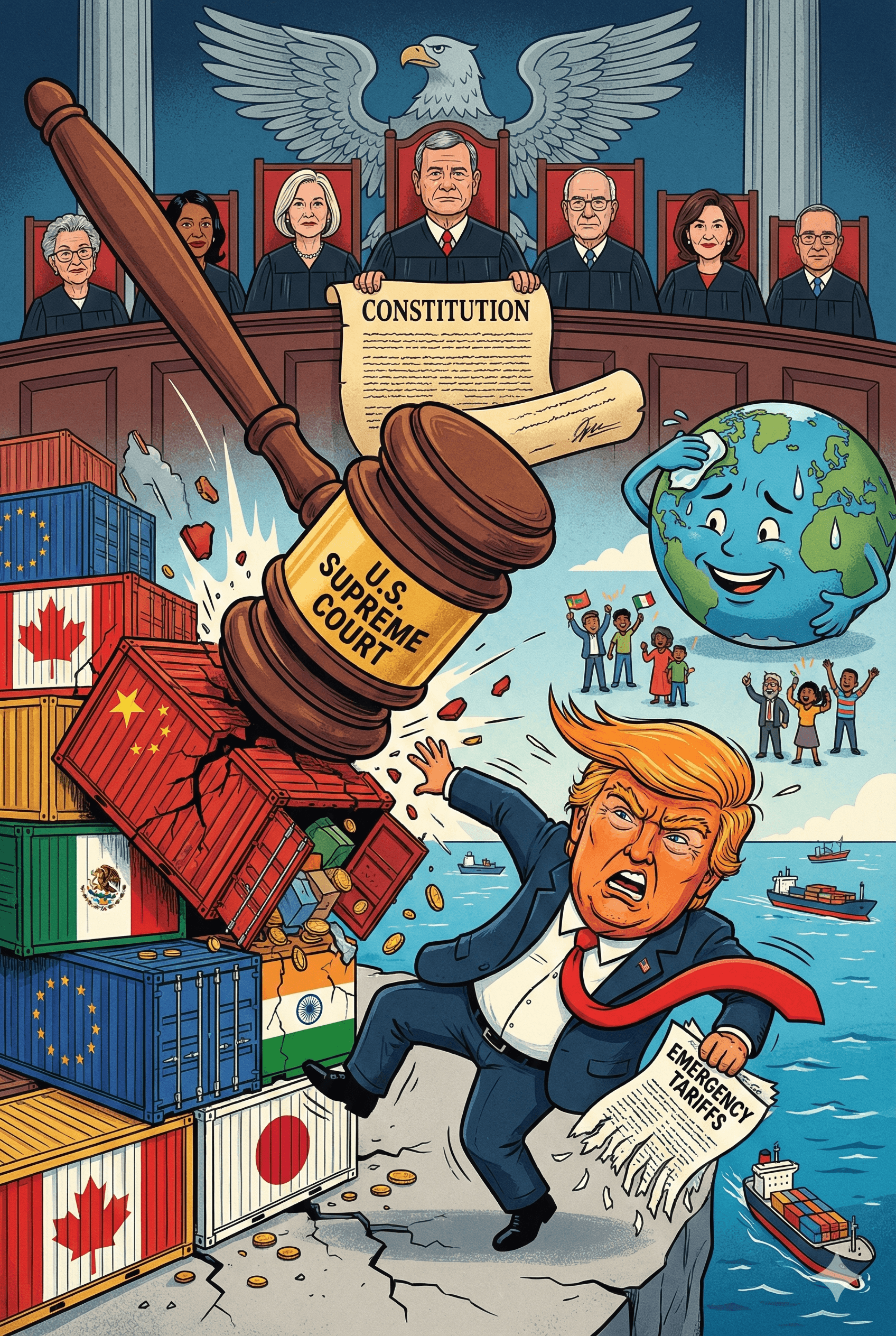
WASHINGTON — In a landmark 6-3 decision, the U.S. Supreme Court has struck down the sweeping global tariffs imposed by President Donald Trump. The ruling, delivered on February 20, 2026, determined that the administration overstepped its constitutional authority by utilizing a 1977 national emergency law to unilaterally levy massive import taxes on virtually all global trade partners.
The decision represents a significant setback for the president’s core economic and foreign policy agenda, shifting the balance of power over trade and taxation back toward Congress. However, it also introduces a new wave of uncertainty for international markets, as the administration has immediately vowed to find alternative legal avenues to maintain its strict protectionist trade policies.
The Background: IEEPA and the "Liberation Day" Tariffs
At the center of the legal dispute was the International Emergency Economic Powers Act (IEEPA). Enacted under President Jimmy Carter in 1977, the law was historically utilized by the executive branch to freeze assets, regulate financial transactions, or impose targeted sanctions on hostile nations and terrorist organizations during times of severe national crisis.
In April 2025, President Trump declared a national emergency regarding chronic U.S. trade deficits and border security issues. Invoking IEEPA, he announced what he termed "Liberation Day" tariffs—a baseline duty of 10% on most global imports, scaling up to reciprocal tariffs of 25% or higher on select nations, including long-standing allies and key trading partners.
Small businesses and a coalition of state governments quickly sued the administration. They argued that the unilateral imposition of such taxes caused severe economic harm, increased supply chain costs, and violated the U.S. Constitution, which explicitly reserves the power of taxation for the legislative branch. After lower courts—including the U.S. Court of International Trade—ruled against the administration, the case was fast-tracked to the Supreme Court.
The Supreme Court's 6-3 Ruling
Chief Justice John Roberts authored the majority opinion, joined by conservative Justices Neil Gorsuch and Amy Coney Barrett, alongside the court's three liberal justices: Sonia Sotomayor, Elena Kagan, and Ketanji Brown Jackson.
The majority concluded that the president lacked the constitutional and statutory authority to impose tariffs of this magnitude without explicit congressional approval. Roberts emphasized that the IEEPA contains "no reference to tariffs or duties" and that the word "regulate" within the statute cannot be stretched to authorize indefinite, sweeping taxation.
Applying the "major questions doctrine"—a legal principle requiring the executive branch to point to clear congressional authorization for actions of vast economic and political significance—the Court found the administration's interpretation of the law unconstitutional.
“The Framers did not vest any part of the taxing power in the Executive Branch,” Chief Justice Roberts wrote, cementing that the taxation power squarely belongs to Congress. The Court noted that allowing such an interpretation would leave the president unconstrained by standard procedural limitations, free to issue a dizzying array of market modifications at will.
The Dissenting View
Justices Brett Kavanaugh, Clarence Thomas, and Samuel Alito dissented. Writing for the dissent, Justice Kavanaugh argued that tariffs have historically been a common and traditional tool used to "regulate importation." He warned that limiting the executive branch's flexibility under IEEPA could hinder the president's ability to respond swiftly to genuine foreign threats and economic crises. Justice Thomas further questioned the scope of the major questions doctrine itself, suggesting that Congress may constitutionally delegate significant powers to the president without the stringent clarity demanded by the majority.
Economic Implications and the Refund "Mess"
The economic ramifications of the Supreme Court ruling are immediate and staggering. Since their implementation, the IEEPA-based tariffs have generated an estimated $175 billion to $300 billion in revenue. These costs were largely absorbed by U.S. importers through bonds posted with Customs and Border Protection, and ultimately passed down to American consumers in the form of higher retail prices.
One of the most pressing questions left unresolved by the Supreme Court is whether these funds will be refunded to the businesses that paid them. The Supreme Court remanded the logistical issue of refunds back to the U.S. Court of International Trade. During oral arguments, the prospect of issuing mass refunds was described as a logistical "mess," a sentiment echoed by Justice Kavanaugh in his dissent. Because many companies have already passed the costs on to consumers, determining who is legally entitled to a refund will likely trigger years of complex litigation.
Political Fallout and Global Reaction
The ruling is a decisive victory for U.S. importers, retail chains, and international trading partners who have navigated volatile supply chain costs over the past year. Trade ministers from nations like Canada quickly praised the decision, reinforcing their stance that the sweeping tariffs were unjustified and disruptive to frameworks like the Canada-United States-Mexico Agreement (CUSMA).
Financial markets reacted with cautious optimism. Wall Street remained relatively calm, with major indices like the S&P 500 ticking up slightly, as investors had largely anticipated the legal outcome. However, traders remain tentative about the long-term effects, fully aware that the administration's trade war is not finished.
Despite the legal defeat, President Trump remains fiercely committed to his tariff-centric economic strategy. Following the ruling, the president stated that the matter could take years to litigate in lower courts, but insisted that bilateral trade agreements negotiated under the pressure of the original tariffs—such as his ongoing deals with India—would remain intact.
Furthermore, the president announced his intention to pursue "alternative authorities" to reinstate the tariffs. He indicated a swift pivot toward other trade statutes, such as Section 232 or Section 301, which require specific administrative investigations into national security threats or unfair trade practices but offer different avenues for executive action. Shortly after the ruling, he verbally announced a new 10% global tariff utilizing these alternative legal frameworks.
Outlook: What Happens Next?
The Supreme Court’s rejection of Trump's global tariffs sets a definitive constitutional boundary on presidential emergency powers. Moving forward, any administration seeking to fundamentally reshape global trade through broad, unilateral taxation will likely face insurmountable legal hurdles without the explicit cooperation of Congress.
For the global economy, the ruling provides a measure of temporary relief from the unprecedented IEEPA tariffs and reasserts the rule of law over international trade disputes. However, with the administration immediately pivoting to alternative legal mechanisms, the U.S. trade war is far from over. Businesses, importers, and international markets must now prepare for a prolonged period of regulatory uncertainty, complex trade litigation, and shifting economic policies.
#USSupremeCourt #GlobalEconomy #TrumpTariffs #InternationalTrade #Geopolitics #USPolitics #SupplyChain #Macroeconomics #TradeWar #EconomicPolicy