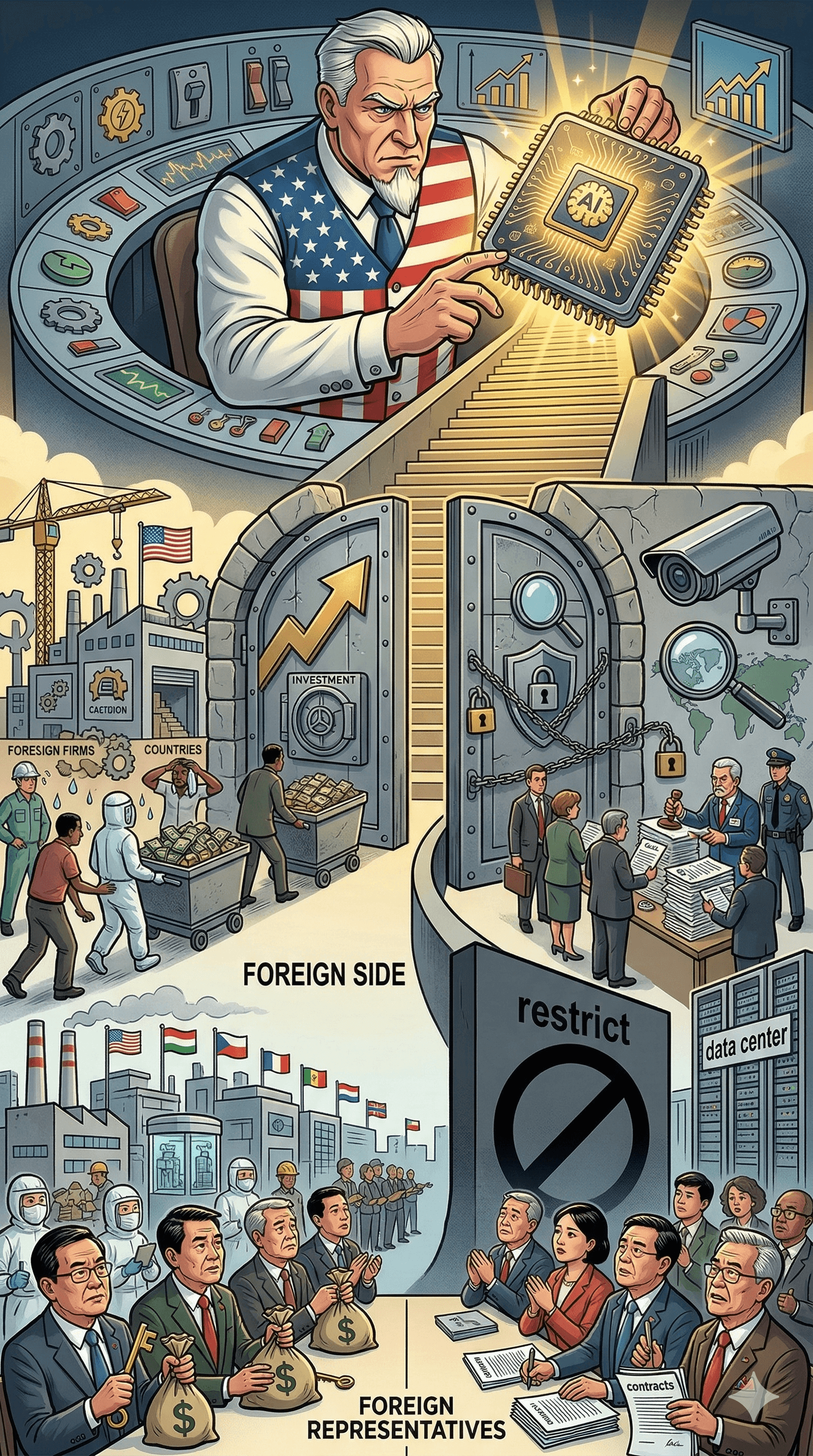
The United States government is currently evaluating a sweeping new regulatory framework to govern the export of advanced artificial intelligence (AI) chips. In a move that could significantly alter the global technology landscape, draft proposals suggest that foreign nations and tech companies seeking large shipments of U.S.-designed AI processors may soon be required to invest directly in American AI infrastructure or provide stringent national security guarantees.
As artificial intelligence computing power becomes one of the world's most critical strategic resources, Washington appears poised to leverage its dominance in semiconductor design to shape global AI development and attract foreign capital.
A Shift Toward "Compute Diplomacy"
The proposed regulations, currently being debated by U.S. officials, mark a significant departure from the policies of former President Joe Biden’s administration, which generally exempted close allied nations from the strictest export limitations. The current Trump administration has signaled a pivot toward a more transactional approach, frequently referred to as "compute diplomacy."
In a recent statement published on the social media platform X, the U.S. Commerce Department confirmed that internal discussions are underway regarding new export rules. The department explicitly distanced itself from the previous administration's "AI diffusion" framework, criticizing it as “burdensome, overreaching, and disastrous.” Instead, officials are aiming for a strategy that firmly anchors the global expansion of AI to the American technology stack and domestic economy.
Tiered Licensing and Strict Monitoring Requirements
According to draft documents reviewed by Reuters, the newly proposed export regime would establish a tiered, worldwide licensing system based on the computing scale of the buyer. The framework is designed to give the U.S. government granular control over where and how advanced AI accelerators—such as those produced by Nvidia and Advanced Micro Devices (AMD)—are deployed globally.
The draft outlines several operational tiers:
Under 1,000 Chips (Small-Scale): Even relatively small semiconductor installations could require explicit export licenses. To qualify for exemptions, semiconductor exporters like Nvidia or AMD would be mandated to actively monitor the hardware. Furthermore, recipients must agree to implement strict software controls preventing the chips from being linked into massive computing "clusters"—the standard configuration required to train cutting-edge, large language models (LLMs).
Up to 100,000 Chips (Mid-Scale): Foreign tech companies or nations seeking to import tens of thousands of advanced processors would need to provide formal, government-to-government assurances regarding the end-use and security of the technology.
200,000 Chips or More (Large-Scale): For massive, gigawatt-scale data center buildouts, the U.S. may demand that the purchasing country commit to matching investments in American AI data centers. Additionally, these large-scale deployments could trigger mandatory on-site inspections by U.S. export control officials to verify ongoing compliance.
Notably, the draft document does not currently include restrictions on the export of "model weights"—the core, closely guarded parameters of trained AI systems developed by companies like OpenAI and Anthropic. The previous administration had considered placing heavy restrictions on model weights to keep advanced AI deployment within trusted environments.
Following the Middle East Blueprint
The foundation for this new global strategy was laid in late 2025 through landmark bilateral agreements with Middle Eastern nations. Last November, the U.S. Commerce Department authorized the export of up to 35,000 highly coveted Nvidia Blackwell (GB300) chips to two state-backed entities: G42 in the United Arab Emirates and Humain in Saudi Arabia.
These approvals were not granted unconditionally. They were deeply tied to rigorous security protocols and multi-billion-dollar commitments from both nations to invest in the U.S. domestic AI ecosystem. The Commerce Department recently highlighted these deals, stating, "We successfully advanced exports through our historic Middle East agreements, and there are ongoing internal government discussions about formalizing that approach."
If this blueprint is applied globally, nations across Europe and Asia hoping to build "sovereign AI" capabilities—such as massive data center projects in France or India—could face steep financial and diplomatic prerequisites before acquiring American hardware.
Geopolitical Motivations and Security Concerns
The motivations behind the proposed U.S. AI chip export rules are twofold: economic leverage and national security.
Economically, the framework aligns with the Trump administration’s overarching priority to draw massive tech infrastructure development and foreign direct investment back to the United States.
From a security standpoint, the rules are designed to prevent the unauthorized diversion of advanced processing power to restricted geopolitical rivals. While countries like Russia remain blacklisted and China faces severe restrictions, U.S. officials worry that advanced chips sold to third-party nations could be accessed by Chinese tech firms via proxy cloud computing services.
Saif Khan, a former national security official who currently serves at the Washington-based Institute for Progress, noted the dual-edged nature of the proposal. "The rule could help the U.S. government address chip diversion to China and ensure a more secure buildout of the most powerful AI supercomputers," Khan explained. "But the license requirements are overly broad, applying globally, raising concerns that the administration intends to use the controls as negotiation leverage with allies rather than for security."
Market Reaction: Semiconductor Stocks Dip Amid Red Tape Fears
The global tech industry has reacted to the proposed framework with cautious apprehension. Following the news leaks, major semiconductor stocks experienced a slight downturn, with Nvidia shares sliding nearly 1.9% and AMD dropping roughly 2.3% during intraday trading.
Market analysts warn that transforming the U.S. government into the ultimate gatekeeper for global AI hardware could introduce severe bureaucratic bottlenecks. A worldwide licensing regime may cause prolonged delays for international data center projects, potentially slowing the sales momentum for semiconductor giants and hindering global tech expansion.
Outlook: The Future of the Global AI Race
As the regulatory draft continues to be debated in Washington, the global implications are already coming into focus. The U.S. is signaling that it does not intend to halt the export of AI chips, but rather to ensure that the ongoing global AI revolution remains fundamentally tethered to American interests.
Foreign governments and multinational corporations will increasingly need to navigate a complex web of trade negotiations, security audits, and mandated domestic U.S. investments to secure the computing power necessary for the future. As the global compute marathon accelerates, access to the finish line may require paying a heavy toll at the American gate.
#AIChips #Semiconductors #USPolitics #Geopolitics #Nvidia #AMD #TechNews #GlobalEconomy #ArtificialIntelligence #ExportControls #TechPolicy #DataCenters