The 2026 FIFA World Cup kicks off in two days — but one team's presence on American soil has turned the planet's biggest sporting event into a live geopolitical flashpoint.
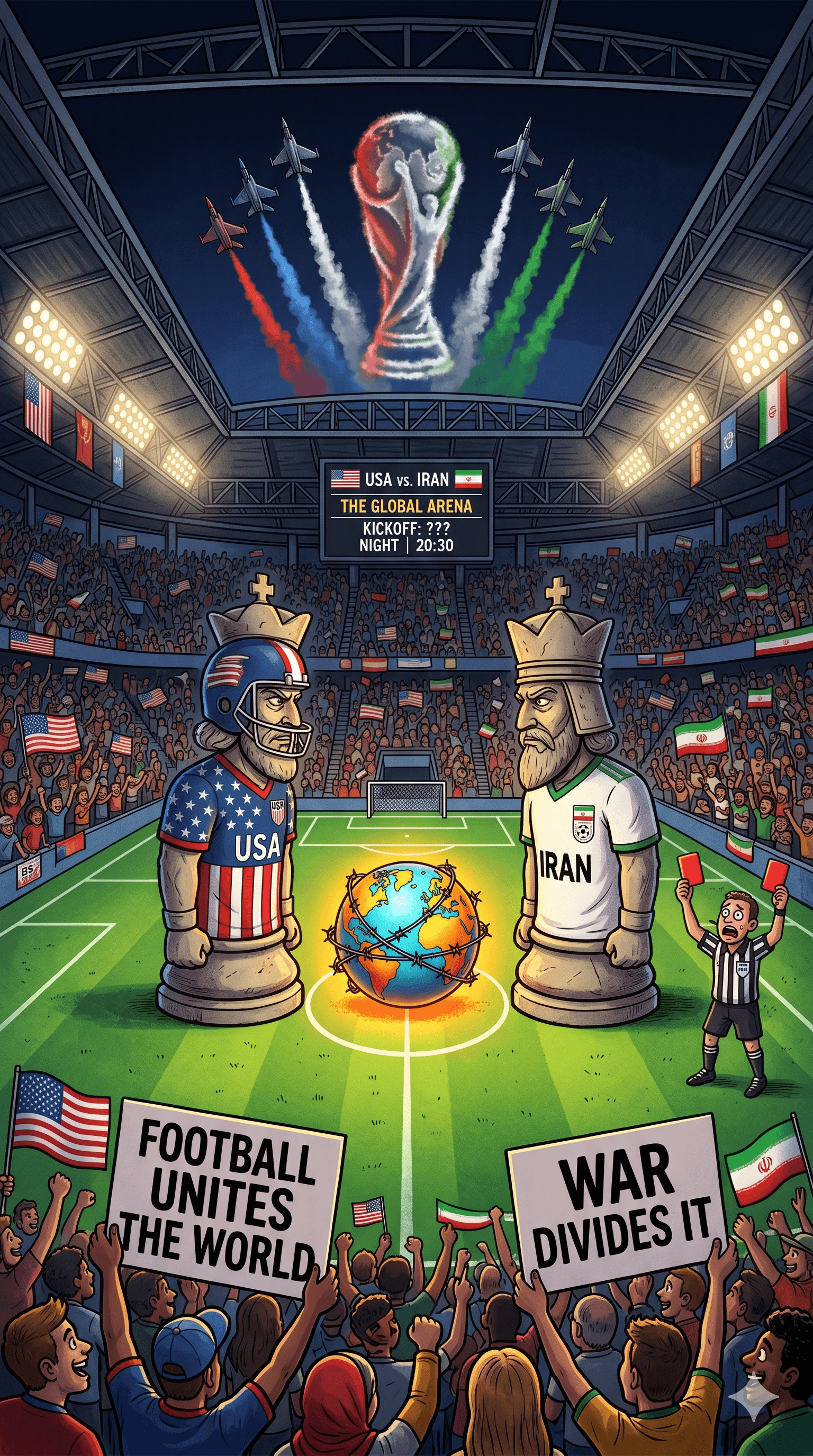
On June 11, the United States, Canada, and Mexico will jointly host the most ambitious World Cup ever staged — 48 nations, 104 matches, 16 cities, and billions of viewers worldwide. FIFA's mantra has always been that "football unites the world." But as the tournament opens, one storyline threatens to overshadow everything on the pitch: Iran is playing in America's backyard, while America and Iran are still, technically, at war.
A Team at War With Its Host
The saga began on February 28, 2026, when the United States and Israel launched coordinated airstrikes against Iran, triggering a regional conflict that has killed thousands and rattled global energy markets. Within weeks, Iran's sports minister declared his country's players would "under no circumstances" participate in a tournament hosted by what he called a "corrupt regime." Iran's football federation president Mehdi Taj echoed the sentiment, citing Trump's own words — the US president had publicly suggested Iran's players might not be safe on American soil.
Yet football proved harder to stop than missiles. FIFA president Gianni Infantino attended Iran's 5-0 friendly victory over Costa Rica in March, posting publicly that "FIFA will continue to support the team to ensure the best possible conditions." Iran ultimately agreed to participate — but on extraordinary terms. The team's training base is in Tijuana, Mexico, just across the California border, allowing players to travel daily into the United States for matches without permanently residing in the country. All three of Iran's Group G games are scheduled on the US West Coast — against New Zealand (June 15) and Belgium (June 21) at Los Angeles Stadium, and Egypt (June 26) in Seattle.
Visas, Officials, and FIFA's Nightmare
The logistical complications have been staggering. At least 14 Iranian backroom staff and officials — including the federation's secretary-general and a vice president — have reportedly been denied US visas. Iran's football federation formally called on FIFA to "hold the US accountable for violations of its rules and discriminatory treatment." FIFA finds itself caught between its own foundational principles of political neutrality and the sovereign immigration authority of the host nation. The organization can lobby; it cannot override US law.
Canada added another layer of friction when Mehdi Taj, Iran's football federation president, was reportedly blocked from entering the country ahead of a FIFA Congress event — a moment that Iran's officials described as deeply symbolic. If senior administrators face visa restrictions before the tournament even begins, the implication is clear: participation itself remains fragile.
The Ghost Game: USA vs. Iran
Hovering above all of this is a prospect that has electrified analysts, fans, and diplomats alike — a potential USA vs. Iran match. The 1998 World Cup clash between the two nations remains one of football's most politically charged moments; Iran won 2-1 in a game weighted with decades of hostility. In 2026, with an active war as backdrop, a rematch would be unlike anything sport has ever produced. Iran is in Group G alongside Belgium, Egypt, and New Zealand; the United States is in Group C. A meeting would require both teams to advance deep into the knockout rounds. It is not inevitable. But it is not impossible — and the mere possibility has become a story unto itself.
Football as a Diplomatic Stage
Iran's situation is the most acute, but it is not the only geopolitical undercurrent running through the 2026 tournament. For the United States, the World Cup is an opportunity to project global openness and soft power at a moment when American foreign policy has become defined by tariffs, sanctions, and military action. For Mexico, hosting Iran's training camp while simultaneously being co-host to the US creates a quiet but significant diplomatic signal. For FIFA, the 2026 tournament was already historically complex — three host nations with different legal systems and border controls, the largest field in World Cup history, and unprecedented security demands. Iran turned it into something more: a test of whether international sport can survive contact with international conflict.
The precedent matters. Every symbolic act by Iranian players — a gesture, a silence, an armband, a celebration — will carry weight far beyond sport. Every visa denial, every security restriction, every press conference answer from Infantino will be parsed for geopolitical meaning. When Iran's players step onto the pitch at SoFi Stadium in Los Angeles — if they do — they will be doing so in the city of a nation currently bombing their country. That is not a sports story. It is history in a jersey.
What Happens Next
The ceasefire between the US and Iran, brokered via Pakistan and fragile since April, is already showing cracks — Israel and Iran exchanged direct strikes on June 8. A full collapse of talks before Iran's June 15 opening match could trigger another withdrawal threat. FIFA has no contingency plan that has been made public. The world will be watching — not just for goals, but for what happens when the whistle blows and two nations at war line up on opposite sides of a pitch.