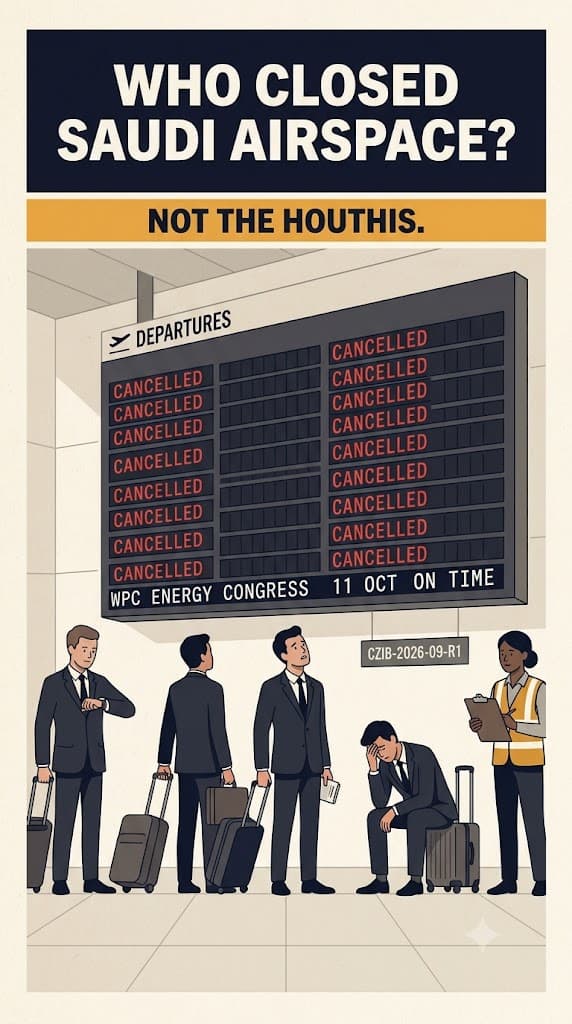
On Monday, around a hundred energy ministers and some five hundred chief executives are due in Riyadh for the 25th WPC Energy Congress. On Thursday afternoon, just under half of Riyadh's departures were cancelled.
Both of those things are still true as of this writing. That is the story.
What happened, in order
The sequence matters more than any single event in it. It also matters that there were two separate attacks this week, not one — a distinction a lot of coverage has lost, and one we come back to below.
30 September. The European Union Aviation Safety Agency issued Conflict Zone Information Bulletin CZIB-2026-09 for FIR Jeddah, the flight information region covering Saudi Arabian airspace. The operative recommendation at this stage was narrow: do not fly, at any level, inside a defined block in the south and south-west, along the Yemeni border. Everywhere else in the FIR got a caution advisory.
5 October. A body calling itself the Houthi-run Humanitarian Operations Coordination Center issued a statement — carried by Saba, and by Al-Masirah TV — saying Saudi skies would become a "theater of operations," and that the airspace would remain unsafe while what it called Saudi aggression continued.
6–7 October. Airports at Riyadh and Abha were struck. Saudi authorities reported three killed — two women, a Moroccan and an Algerian national, at Abha, and a Sudanese resident at Riyadh — and 36 injured, 28 at Abha and 8 at Riyadh. Najran International Airport was also hit, with material damage and three injured; Saudi authorities announced that one themselves.
8 October. King Khalid International was attacked again. A Saudia aircraft on the ground was severely damaged by fire. Saudi authorities reported three more dead, all Saudi citizens, among them the Saudia pilot Captain Hamoud Ali Alkalthami.
That brings the week's confirmed toll to at least six, across two distinct incidents.
8 October, afternoon. Cirium counted 49.7% of Riyadh departures cancelled by 1500 GMT. Lufthansa Group suspended Riyadh flights through 16 October. IndiGo cancelled through 9 October; Air India and Akasa Air through 10 October. Emirates and Etihad cancelled services on 9 and 10 October. One Air India Delhi–Riyadh flight turned back mid-route.
9 October. EASA revised the bulletin to CZIB-2026-09-R1, broadening the no-fly recommendation to take in areas around Riyadh, Dammam and Madinah — reportedly because, in the agency's assessment, the Houthis can and intend to strike deeper inside Saudi territory, including the capital, creating a risk of civil aircraft being misidentified. The bulletin runs to 16 November unless reviewed earlier.
Separately, and going further than EASA, the industry advisory group OPSGROUP told its members it now recommends avoiding operations in Saudi Arabia entirely.
11 October. The Congress opens.
The thing worth understanding
A paramilitary group in Yemen cannot close Saudi airspace. It has no authority to issue a NOTAM, no seat at ICAO, no power to ground a single aircraft.
It does not need any of that. It only needs to make the machinery that can close airspace do the closing for it.
That machinery is a chain, and every link in it is built to be risk-averse by design:
A threat is made, and then demonstrated.
A regulator publishes a bulletin. EASA's CZIB is advisory in form — it recommends. But an EU operator that flies into a named box after a bulletin names it is constructing an argument it does not want to have to make later.
Each airline's safety management system runs its own risk assessment, and that assessment now has a regulator's document sitting inside it.
War-risk underwriters reprice, or decline.
The schedule is cancelled — not by a government, and not by the Houthis, but by a dispatcher and an actuary.
Nobody in that chain works for the group that issued the threat. Every one of them acted correctly. The departures board empties anyway.
This is among the cheapest force multipliers available in modern conflict. A missile that damages one parked airliner has done a bounded amount of direct damage. The same missile, by converting a rhetorical threat into a demonstrated one, turns an advisory into a constraint — and the constraint costs the Saudi economy something far larger, in cancelled traffic, in reinsurance, and in the quiet repricing of forward bookings into the Kingdom through November.
Readers who followed our Hormuz coverage will recognise the shape. The mechanism is the same: a cheap weapon imposing asymmetric cost on a system that cannot be economically defended, because the system's own safety culture does the expensive part on its behalf.
Where the sourcing is thin
We publish this section on every post. This week it is unusually important, because the reporting itself has gone wrong in a specific way.
The two attacks are being merged. Aggregators and secondary coverage have repeatedly combined the 6–7 October Riyadh-and-Abha attack with the 8 October Riyadh attack, producing a single "three killed" figure and an injury count that appears contested when it isn't. It isn't contested. 36 is the official figure for 6–7 October, broken out by airport and nationality. "Several" is the uncounted figure for 8 October. They are different events. If you see one toll of three for the week, you are reading a merge.
What the aircraft damage actually was, officially, is undetermined. Saudia's own statement says the aircraft "sustained damage while on the ground." GACA confirmed that two attacks targeted airport facilities and an aircraft — attacks, not confirmed impacts. The Houthis claimed one ballistic missile caused the damage. The coalition said it intercepted and destroyed two ballistic missiles aimed at Riyadh. Reuters sources suggested the aircraft may have been struck by shrapnel from an interception. Aviation outlets, reading photographs of a burned-out fuselage, have called it a destroyed A320 and a hull loss. That is a reasonable inference from the images. It is still an inference, and no official write-off has been published. One AFP source said three aircraft were hit.
Claimed by an interested party: the Houthi claim on Khamis Mushait air base, made 7 October — though note the coalition said it intercepted a missile aimed at Khamis Mushait, which corroborates an attempt while denying a hit. Also the coalition's own claim to have destroyed three truck-mounted rocket launchers at separate locations, and to have struck 82 Houthi military sites in Saada, Hodeidah, Jawf and Marib. Both sides are describing their own successes.
Correcting ourselves in advance: Najran is not in the unconfirmed tier. Saudi authorities announced that strike.
Single-outlet: the report that diplomats in Riyadh were told to shelter in place was carried by Euronews; several major wires covering the same events did not report it.
On the EASA bulletin itself: the metadata — number, dates, FIR, expiry — is public on EASA's site. The full recommendation text and the waypoint coordinates are not retrievable from the public page at the time of writing; the waypoint strings circulating in coverage come from secondary outlets, and we have not been able to confirm them against the bulletin PDF. We are telling you that rather than presenting a quote we cannot stand behind.
What the other side of this looks like
It would be easy to write this as "Saudi airspace is closed." It isn't.
Saudi Arabia's General Authority of Civil Aviation said airport operations had resumed and air traffic had returned to normal; Saudia said its own operations were normal from 6pm on 8 October. The majority of flights into the Kingdom still operate. EASA's bulletin names defined blocks and recommends caution elsewhere — that is not a prohibition on the country.
The honest complication is OPSGROUP, which has gone further than the regulator and told its members to avoid Saudi Arabia altogether. That is an industry advisory rather than a legal instrument, and airlines are not bound by it. But it is the clearest signal that professional opinion is running ahead of the official line, and anyone arguing this is a contained disruption has to account for it.
What we have, then, is a serious disruption, a real and rising death toll, a genuine regulatory constraint, and a private-sector risk community that is more worried than the published rules require — with the system still absorbing it rather than collapsing.
The question the Congress cannot avoid
The 25th WPC Energy Congress is themed "Pathways to an Energy Future for All." Supply security and reliability sit near the top of its agenda.
It convenes in a city where, three days earlier, an airliner burned on the ground and a European regulator told airlines not to overfly parts of the country at any altitude.
Nobody chose this backdrop, and the timing is miserable luck rather than irony. But the people arriving on Monday are the people who spend their working lives pricing exactly this: the gap between a facility's physical security and its economic security, and what the second costs when the first is merely questioned.
The attacks did not stop Saudi oil production. They did not need to. They made it more expensive to be near Saudi oil production, using hardware that costs a rounding error against the thing it repriced.
What to watch
16 November. The expiry on CZIB-2026-09-R1. Whether it lapses, narrows or rolls forward is the most honest single indicator of whether this is an episode or a condition.
Lufthansa's 16 October restart. The group named a date rather than suspending open-endedly. If that date slips, other carriers' risk teams will notice before any ministry does.
Whether OPSGROUP softens. It moved ahead of the regulator going in; it will likely move ahead of the regulator coming out.
War-risk premiums into the Kingdom. They are not published, and they move before anything else does. If someone tells you they have gone up, ask them how they know.
The attendance figures. The organisers and the Saudi Ministry of Energy have projected around 100 ministers, close to 500 CEOs and 25,000-plus delegates from more than 80 countries; one trade-press figure circulating is much lower, at 70 ministers and 300 CEOs. All of these are projections made before this week. The gap between the projection and the room is the measurement nobody will volunteer.