A New Strategic Hub in Xinjiang
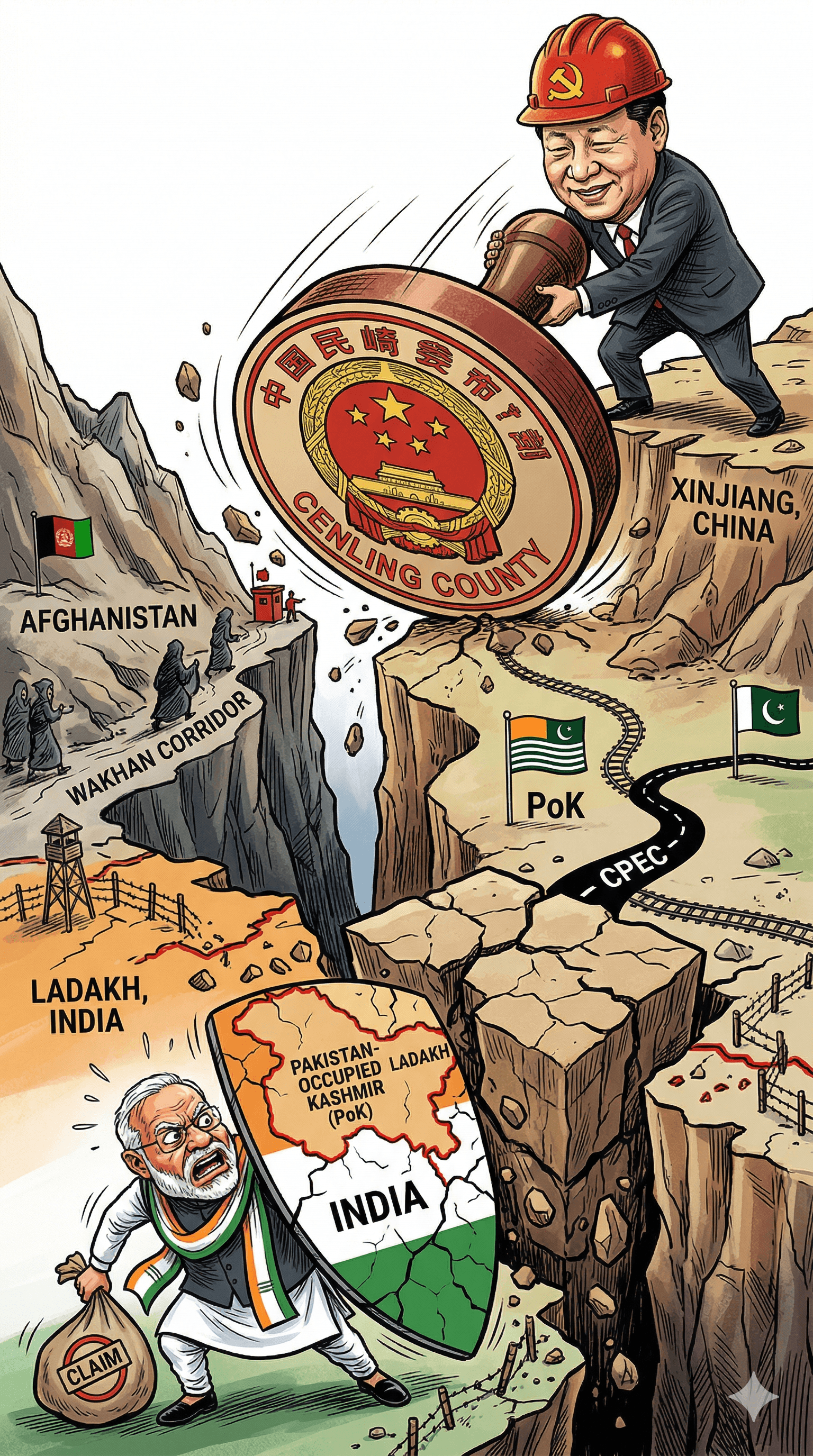
In a move that signals a deepening consolidation of its frontier borders, China has established a new administrative division in its volatile Xinjiang region. Announced on March 26, 2026, by the Xinjiang Uyghur Autonomous Region government, the newly minted "Cenling County" is strategically positioned near the Karakoram mountain range, sitting right on the doorstep of Pakistan-occupied Kashmir (PoK) and the Afghan border.
This development is not an isolated bureaucratic reshuffle. Cenling is the third new county created by Beijing in the predominantly Muslim Uyghur region of Xinjiang in just over a year. Placed under the administration of Kashgar prefecture—a historic gateway city on the ancient Silk Road connecting China with Central and South Asia—the creation of Cenling county carries heavy geopolitical implications. While China frames the move as a domestic security measure, its proximity to highly contested territories guarantees it will exacerbate existing friction with New Delhi.
The Geographical and Strategic Significance of Cenling
To understand why Cenling is making global headlines, one must look at a map. The county is geographically fused to the Wakhan Corridor, a narrow, 74-kilometer-long, high-altitude strip of land in Afghanistan. This rugged geographical bottleneck naturally separates Tajikistan to the north from PoK to the south, effectively acting as a bridge right into China’s Xinjiang province.
Furthermore, Cenling falls under the Kashgar prefecture. Kashgar is not just a historical trade hub; it is the Ground Zero starting point for the controversial $60 billion China-Pakistan Economic Corridor (CPEC). By elevating the administrative status of the surrounding borderlands, Beijing is signaling a massive commitment to fortifying the infrastructure and security apparatus surrounding its premier Belt and Road Initiative (BRI) project.
Why the Creation of Cenling County Irks India
For New Delhi, any unilateral administrative changes by Beijing in regions adjacent to Ladakh or PoK are viewed with profound suspicion and concern. The creation of Cenling is bound to irk India for three primary reasons:
1. The PoK and CPEC Factor
India consistently claims the entirety of Jammu and Kashmir—including Pakistan-occupied Kashmir—as its sovereign territory. Because Cenling borders PoK and acts as a protective buffer for the Kashgar CPEC routes, India views this as China further entrenching its presence in illegally occupied Indian territory. New Delhi has repeatedly protested CPEC on sovereignty grounds, and the militarization or administrative fortification of the Chinese side of this border only deepens the strategic challenge for India.
2. A Pattern of Administrative "Cartographic Warfare"
Cenling is part of a broader pattern. Just last year, India lodged strong official protests with Beijing over the creation of two other Xinjiang counties—Hean and Hekang. New Delhi noted that the jurisdiction of these newly minted Chinese counties overlapped with parts of the Union Territory of Ladakh. Specifically, Hean county includes large swathes of the disputed Aksai Chin plateau, which China occupied during the 1962 war but India legally claims. While Cenling itself borders PoK rather than direct Indian-controlled territory, it reinforces China's strategy of utilizing domestic administrative laws to solidify its grip on contested borderlands.
3. The Rejection of "Fictitious Names"
The geopolitical tension is further fueled by China's ongoing efforts to rename geographical entities along the border. Recently, India’s Ministry of External Affairs (MEA) strongly condemned China’s attempts to assign "fictitious names" to places within Indian territory, such as in Arunachal Pradesh. The MEA has categorically stated that such actions are baseless narratives that inject negativity into bilateral ties and do not alter the undeniable reality of India's territorial integrity. Cenling represents another layer of Beijing unilaterally drawing lines and asserting civil administration in a highly disputed geopolitical neighborhood.
China’s Core Motivation: Securing the Wakhan Corridor
While India views the move through the lens of territorial disputes, Beijing's primary stated motivation for creating Cenling is internal security.
The Wakhan Corridor’s mountainous, porous terrain has long been a security nightmare for China. Beijing has repeatedly expressed concerns that Uyghur separatist militants, specifically those affiliated with the East Turkestan Islamic Movement (ETIM), could utilize the Wakhan Corridor as a backdoor to infiltrate Xinjiang from Afghanistan.
Geopolitical experts widely agree that the creation of Cenling is a defensive, governance-driven move by the Chinese Communist Party. According to Yun Sun, a senior fellow at the Stimson Centre in Washington, the establishment of the county represents a push toward a "stronger grass-roots level government structure for effective governance and control." By upgrading the region to a county, Beijing can allocate more state resources, infrastructure funding, and security personnel to stabilize a frontier historically prone to ethnic turbulence and foreign militant infiltration.
Similarly, Lin Minwang, a professor at the Institute of International Studies at Fudan University in Shanghai, noted that the move reflects China's deeper recognition of the strategic vulnerabilities in its borderlands. To safeguard its territory and the lucrative CPEC trade routes, China is actively moving from a military-only border posture to integrated civil-military governance.
Impact and Outlook
The establishment of Cenling county is a clear indicator that China is digging in for the long haul. By cementing civil administrative structures along the Karakoram range, Beijing is creating undeniable "facts on the ground" that make future border negotiations exponentially more difficult.
For India, this necessitates a continued heightened state of vigilance along the Line of Actual Control (LAC) and an acceleration of its own border infrastructure projects. The geopolitical outlook suggests that the Himalayas will remain a theater of intense "gray-zone" competition. As China transforms remote buffer zones into fully functioning, heavily surveilled counties, the space for diplomatic normalization between the two Asian giants will likely continue to shrink.