South Korean President Lee Jae-myung arrived in New Delhi on April 19, 2026, for a highly anticipated three-day state visit. Accompanied by First Lady Kim Hea Kyung and a high-level delegation of ministers and business leaders, this marks the first visit by a South Korean head of state to India in over eight years.
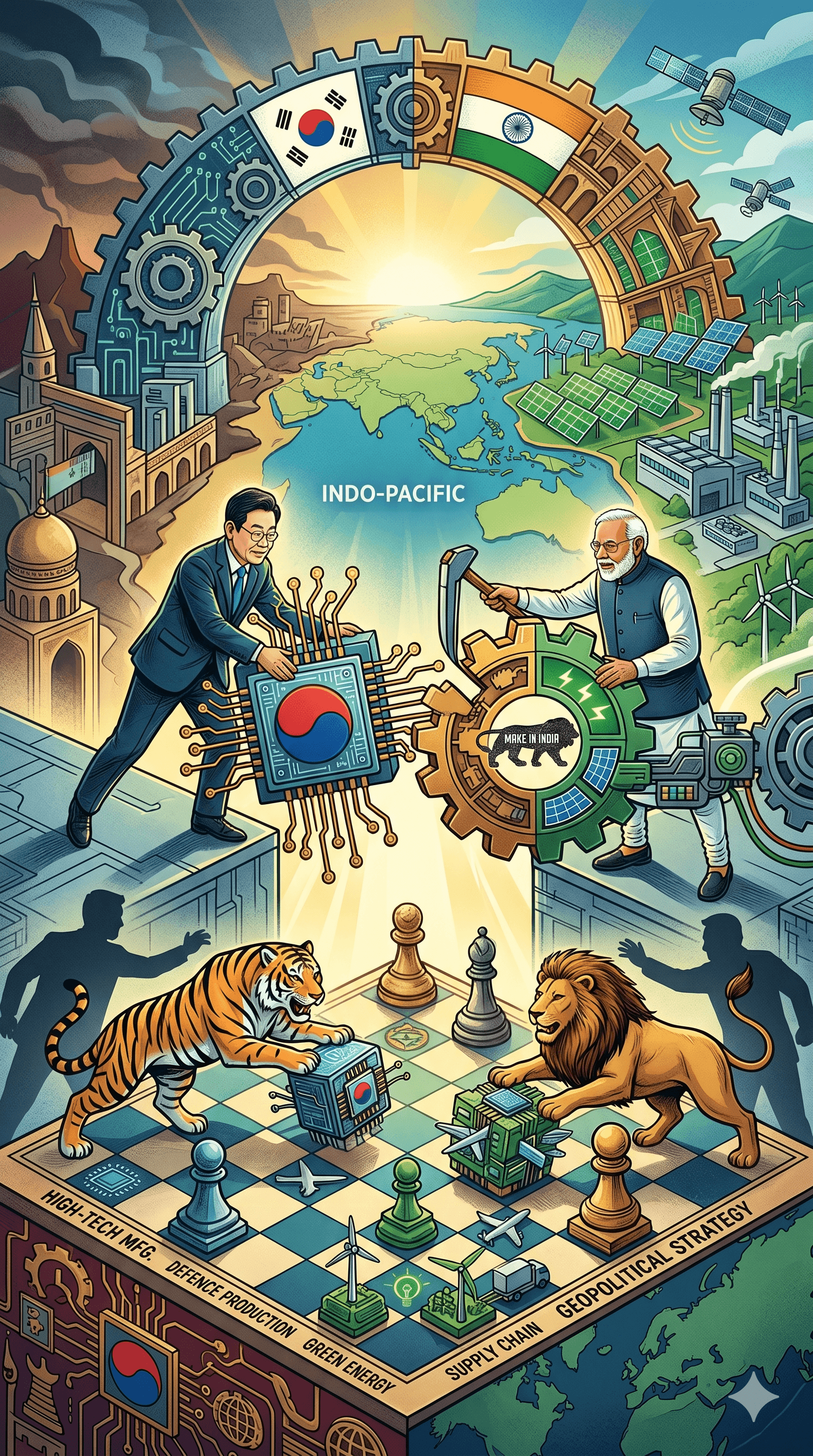
As global supply chains face unprecedented turbulence, this diplomatic engagement is poised to recalibrate the India-South Korea "Special Strategic Partnership" for a new era. What might seem like a standard diplomatic tour is, according to political analysts, a strategic game-changer. From securing green energy and semiconductor supply chains to deepening defense and maritime ties, President Lee’s visit represents a deliberate pivot in Asian geopolitics.
A Reboot of the Special Strategic Partnership
India and South Korea elevated their bilateral ties to a "Special Strategic Partnership" in 2015. However, the absence of sustained high-level diplomatic engagement over the past several years caused joint initiatives to lose traction. President Lee’s visit acts as a critical reboot.
Upon his arrival, President Lee was accorded a ceremonial welcome at the forecourt of Rashtrapati Bhavan, received warmly by President Droupadi Murmu and Prime Minister Narendra Modi. Following an homage to Mahatma Gandhi at Rajghat, the centerpiece of the visit was set at Hyderabad House. Here, President Lee and PM Modi held comprehensive bilateral discussions aimed at framing "India-South Korea Relations 2.0." External Affairs Minister S. Jaishankar also called on the visiting leader, emphasizing a shared commitment to deepening ties across multiple domains.
Economic Integration: High-Tech Manufacturing and CEPA Upgrades
A central pillar of this visit is economic revitalization. Both nations have laid out an ambitious blueprint to double bilateral trade—currently hovering around $25 billion—to $50 billion by 2030.
To achieve this, negotiations are being accelerated to upgrade the Korea-India Comprehensive Economic Partnership Agreement (CEPA), which originally took effect in 2010. The focus has shifted significantly toward high-tech manufacturing, artificial intelligence (AI), semiconductors, and defense production.
Underscoring the economic weight of this visit is the presence of top-tier corporate executives. President Lee’s delegation reportedly includes prominent figures from the Korea Business Association, alongside leaders from tech and automotive giants like Samsung Electronics, Hyundai Motor Group, LG Group, and gaming major Krafton. By bringing the leaders of South Korea's most influential chaebols to New Delhi, Seoul is clearly signaling its view of India not just as a vast consumer market, but as a primary driver of global production.
The Maritime Push: Why Shipbuilding Matters
One of the most notable, yet under-the-radar, strategic aspects of this bilateral summit is the focus on shipbuilding and marine cooperation.
For India, collaborating with a global maritime powerhouse like South Korea is crucial. It promises to reduce New Delhi’s exposure to foreign vessels while building domestic capacity. For South Korea, India offers a highly competitive manufacturing base, a vast skilled workforce, and strategic proximity to major global trade routes. Analysts note that this partnership will allow South Korea to expand its global shipbuilding footprint beyond East Asia while helping India secure its maritime infrastructure.
Navigating Geopolitics: Supply Chains and Global South Diplomacy
Beyond bilateral economics, President Lee’s visit is heavily influenced by the current turbulent world order. Ongoing energy supply disruptions in the Middle East and the ripple effects of shifting U.S. tariff policies have exposed the vulnerabilities of global supply chains. Both India and South Korea, acting as pragmatic middle powers, are actively seeking to insulate their economies by diversifying partnerships.
South Korean National Security Adviser Wi Sung-rak highlighted that the India trip is a cornerstone of Seoul’s "Global South" diplomacy. By engaging deeply with India—a leading voice among developing nations—South Korea is actively looking beyond its traditional Northeast Asian sphere. Following his engagements in New Delhi, President Lee is scheduled to travel to Vietnam to further secure supply chain stability and critical minerals, illustrating a broader strategy to mitigate global uncertainties.
Cultural Diplomacy and People-to-People Ties
While high-tech manufacturing and defense dominate the headlines, both nations recognize that long-term strategic alliances require strong cultural foundations. Bilateral talks have also placed a renewed emphasis on people-to-people connections. The agenda includes discussions on improving visa and entry conditions for South Koreans in India, expanding the reach of K-content (Korean cultural exports), and broadening Korean language education initiatives across India.
These cultural exchanges are designed to build mutual understanding and reduce mental gaps, creating a robust societal bond that can sustain diplomatic momentum even during periods of geopolitical strain.
Impact and Outlook: The Dawn of India-South Korea Relations 2.0
President Lee Jae-myung’s state visit to India is more than a diplomatic courtesy; it is a calculated response to a changing global landscape. By addressing stalled negotiations and identifying new sectors for growth—such as AI, green energy, and critical technologies—both countries are turning a period of global uncertainty into an opportunity for strategic alignment.
The true test will be maintaining this momentum once the immediate external pressures of the current geopolitical climate subside. However, if the proposed joint ventures in semiconductors, defense, and shipbuilding materialize as planned, this visit will undoubtedly be remembered as the moment India and South Korea successfully insulated their shared future and forged a formidable partnership in the Indo-Pacific.