NEW DELHI — Tensions in the highly volatile Middle East have officially spilled into critical global shipping lanes, raising alarm across international energy markets. A newly surfaced distress audio recording has exposed the chaotic moments when the Iran Navy opened fire on Indian-flagged tankers in the Strait of Hormuz. Despite prior assurances from Tehran that neutral vessels would not be targeted amid its ongoing conflict with the United States and Israel, the sudden attack on commercial shipping has forced New Delhi into an urgent diplomatic confrontation with Iran.
The incident highlights the growing risks to maritime security in a waterway responsible for nearly one-fifth of the world’s crude oil transit, threatening a new wave of global economic instability and severely challenging the safety of the world's most vital energy corridors.
The Incident: Indian Tankers Under Fire
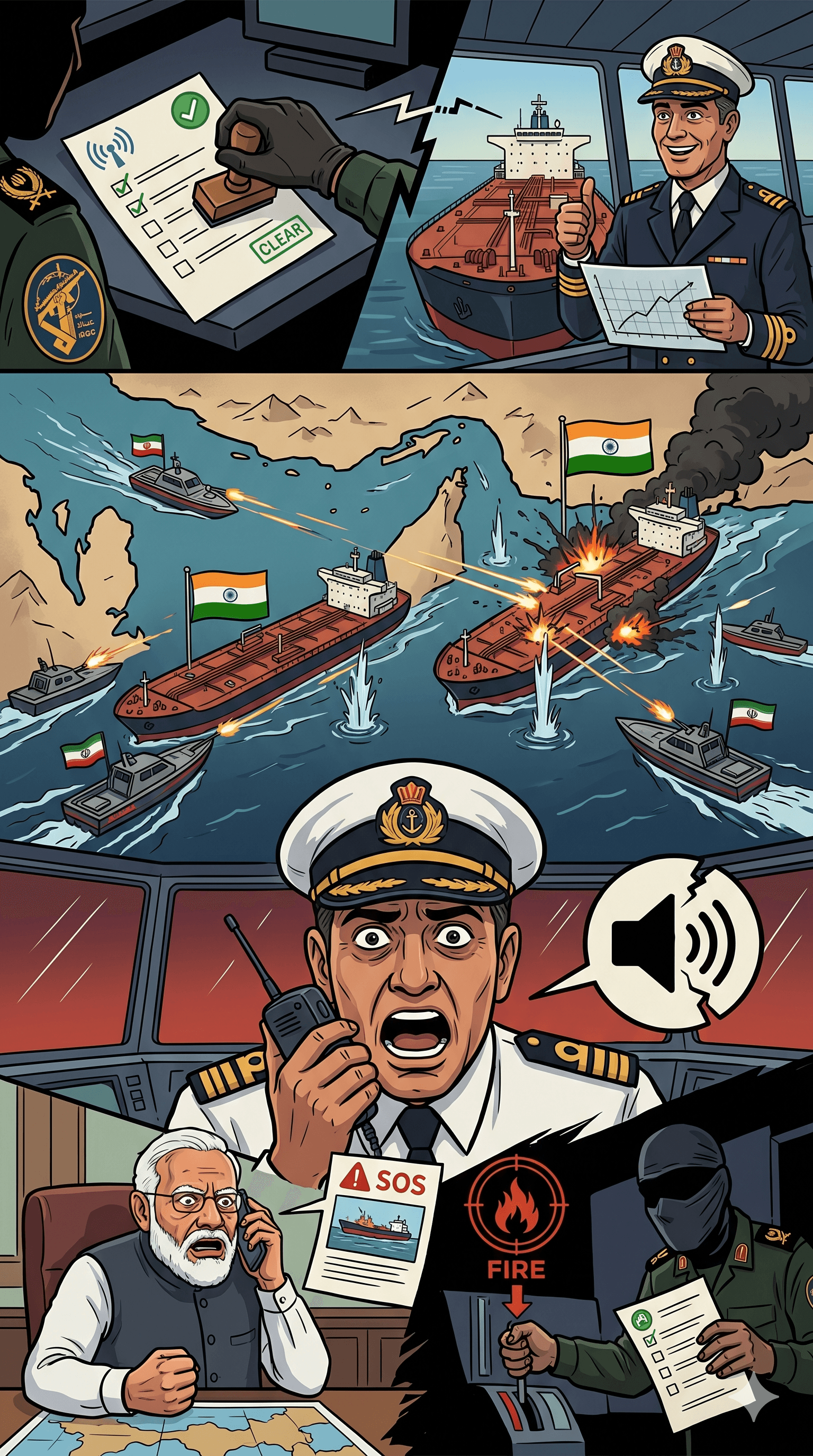
On Saturday, two India-flagged vessels—the Sanmar Herald and the Jag Arnav—were navigating the waters north of Oman when they were abruptly fired upon by Iranian gunboats. The sudden escalation occurred near the highly monitored Green Area of the Strait of Hormuz.
The Jag Arnav, a bulk carrier, was en route from Al Jubail in Saudi Arabia to India. Concurrently, the Sanmar Herald was transporting approximately two million barrels of Iraqi crude oil directly to Indian ports. Following the aggressive maneuvers and live fire from the Iranian Navy, both Indian tankers were forced to abandon their routes and turn back to avoid further damage.
Fortunately, early reports confirmed that there were no casualties, and neither ship sustained structural damage. However, the aggressive interception fundamentally contradicted Tehran’s earlier commitments. Iranian officials had previously stated that countries uninvolved in the US-Israel military campaign would be granted safe passage through the heavily guarded shipping corridor.
Viral Audio Exposes Maritime Confusion
The sheer confusion of the encounter was captured in a frantic 30-second distress call from the Sanmar Herald. The audio, authenticated and shared by the maritime intelligence firm Tanker Trackers, reveals a bewildered crewman desperately attempting to communicate with the Iranian forces amid the chaos.
“Sepah Navy. Sepah Navy. This is motor tanker Sanmar Herald,” the mariner is heard pleading over the radio, referring to the naval forces of the Islamic Revolutionary Guard Corps (IRGC). “You gave me clearance to go. My name is second on your list. You are firing now. Let me turn back.”
The recording underscores a severe breakdown in communication—or a sudden, hostile shift in protocol—by Iranian forces. The Sanmar Herald had reportedly switched off its Automatic Identification System (AIS) while moving east, a common security measure in conflict zones, before switching it back on just prior to the interception.
India’s Swift Diplomatic Fallout
The unprovoked targeting of Indian tankers triggered an immediate and stern response from New Delhi. India’s Ministry of External Affairs (MEA) swiftly summoned the Iranian Ambassador to India, Dr. Mohammad Fathali, to lodge a formal and strong protest over the security breach.
During the high-level meeting with the MEA’s joint secretary for the Pakistan-Afghanistan-Iran desk, the Indian Foreign Secretary conveyed "deep concern" over the shooting. The MEA explicitly emphasized the importance India places on the safety of its merchant shipping and mariners, reminding Tehran that Iran had, until this point, facilitated the safe passage of several India-bound ships.
According to diplomatic sources, the Iranian envoy attempted to de-escalate the situation, communicating that the attack was "not intentional" and instead the result of a severe "communication gap" on the water.
Publicly, Iranian diplomats sought to maintain strong bilateral ties. Dr. Abdul Majid Hakeem Ilahi, the representative of Iran's Supreme Leader in India, stated he was unaware of the specific maritime incident but stressed the deep historical relationship between the two nations. “The relationship between Iran and India is very strong,” Ilahi stated, noting recent successful conversations between the Indian Prime Minister and Iranian President Masoud Pezeshkian. “We don’t want this war. We want peace, and we hope that the other side will also follow peace so that we can have a peaceful area.”
Geopolitical Context: The Strait of Hormuz Crisis
To understand the attack on the Indian tankers, it is essential to look at the broader regional warfare. The Strait of Hormuz currently sits at the epicenter of a severe geopolitical storm that escalated following joint US-Israeli military strikes on Iran on February 28.
In retaliation, Iran announced a closure of the Strait of Hormuz, declaring that the strategic waterway would remain completely shut to traffic until the United States lifted its naval blockade on Iranian ports. The Iranian Navy issued stark warnings that any vessels approaching the chokepoint without explicit coordination would be considered as "cooperating with the enemy" and targeted accordingly.
Despite this full-scale regional conflict, India had successfully maintained steady maritime traffic through the strait. Since the February 28 strikes, at least eight India-linked vessels—including the Shivalik, Nanda Devi, and Green Sanvi—had safely transited the corridor. The sudden firing on the Sanmar Herald and Jag Arnav marks a dangerous deviation from this established safe passage, indicating that the Iranian Navy's enforcement of its maritime blockade is becoming increasingly unpredictable.
With Iran's parliament speaker, Mohammad Bagher Ghalibaf, noting in a televised address that a final peace deal remains "far off" despite some fundamental progress in indirect talks with the US, the volatility in the Gulf is unlikely to subside soon.
Economic Impact and Global Outlook
Global Energy Crisis Looms:
The targeting of Indian tankers in the Strait of Hormuz is not just a regional security issue; it is a profound global economic threat. The strait is the world’s most critical energy chokepoint. India imports more than 85 percent of its crude oil, with the vast majority transiting from the Gulf region through this exact waterway, firmly establishing India as the world’s third-largest oil importer.
If shipping companies deem the risk of Iranian Navy attacks too high, global crude oil prices will inevitably surge, exacerbating inflationary pressures and triggering a broader energy crisis. While no ships were harmed in this specific incident, the distress call from the Sanmar Herald serves as a chilling reminder of how quickly bureaucratic clearance can devolve into live fire.
Future Outlook:
As a fragile two-week regional ceasefire nears its expiration on Wednesday without a permanent peace deal in sight, the outlook for maritime security remains bleak. The Indian Navy's Western Fleet continues to maintain a "close vigil" to protect national interests, but merchant vessels face an environment of extreme unpredictability. Until the broader standoff between Washington and Tehran is resolved, the Strait of Hormuz will remain a high-risk zone, forcing global stakeholders to urgently reconsider their energy supply routes and crisis management strategies.